Campus Safety & Security
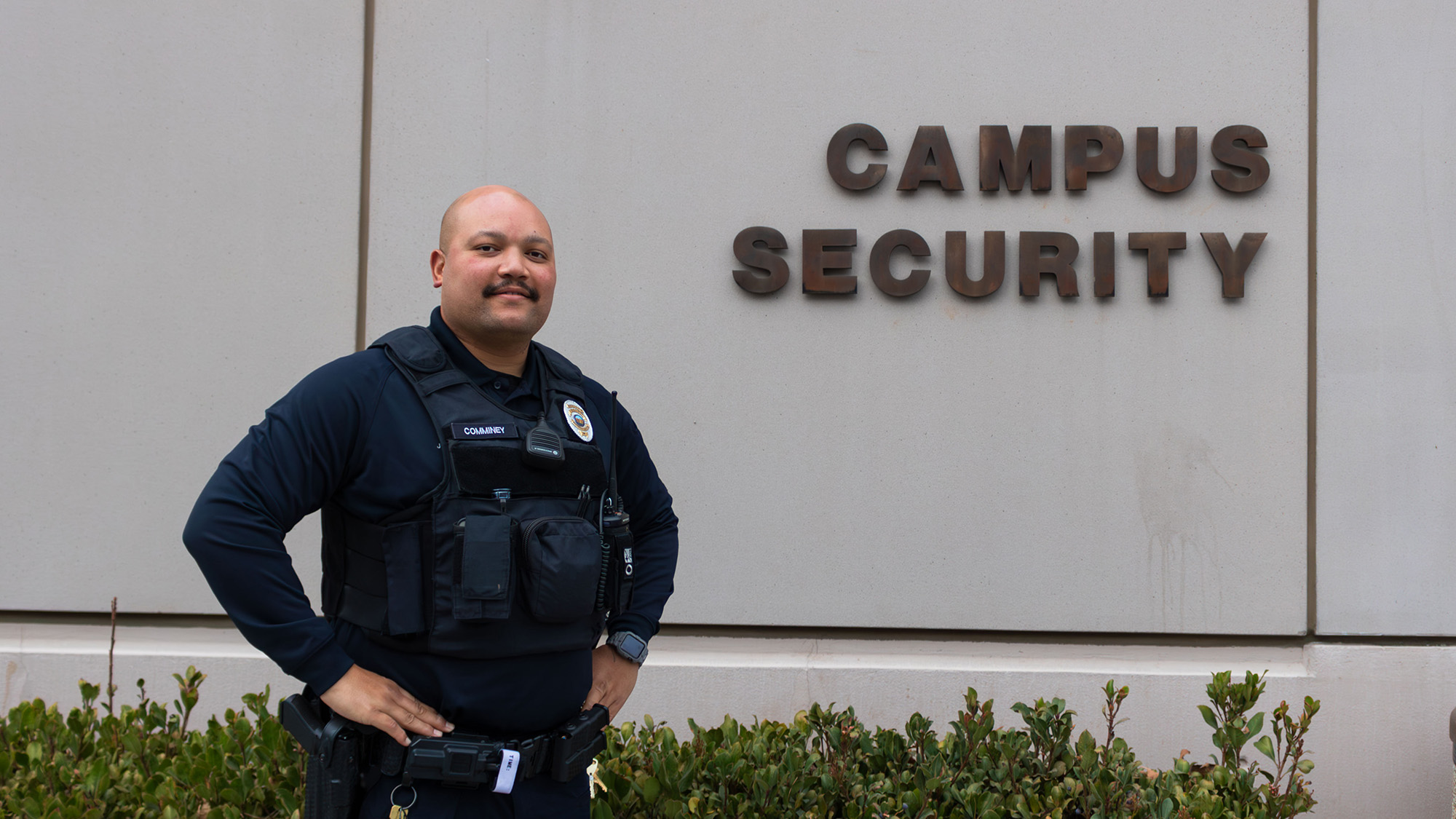
Campus Safety & Security
The mission of District Safety & Security of the Rancho Santiago Community College District is to serve and protect the people and property at all District locations and to ensure a safe and secure educational environment that encourages personal and intellectual growth.
To accomplish this mission, our primary activity is to perform visible and continuous patrols of District properties so that we are available to our students, staff, and guests to perform safety and security services and to deter crime. Each District Safety Officer is expected to carry out the duties of their assignment with courtesy, consideration, empathy, self-control, impartiality, and honesty. The department will work cooperatively with all others in the District to establish mutual trust and respect.
CORE VALUES
-
We place the highest value on preserving human life.
-
We believe that by practicing positive community relations and customer service, we will best achieve a feeling of security in our community.
-
We are accountable and responsive to the community we serve.
-
We believe that dishonesty, distrust, and rudeness do not belong in our department.
-
We respect the dignity, worth, and diversity of all persons.
-
We believe the strength of our department is our employees.
-
We hold an individual’s right to constitutional protection sacred.
-
We encourage open and constructive dialogue between all employees at all levels of our organization.
-
We believe that to inspire confidence and trust in our department, we must work together in a spirit of harmony and cooperation.
Location
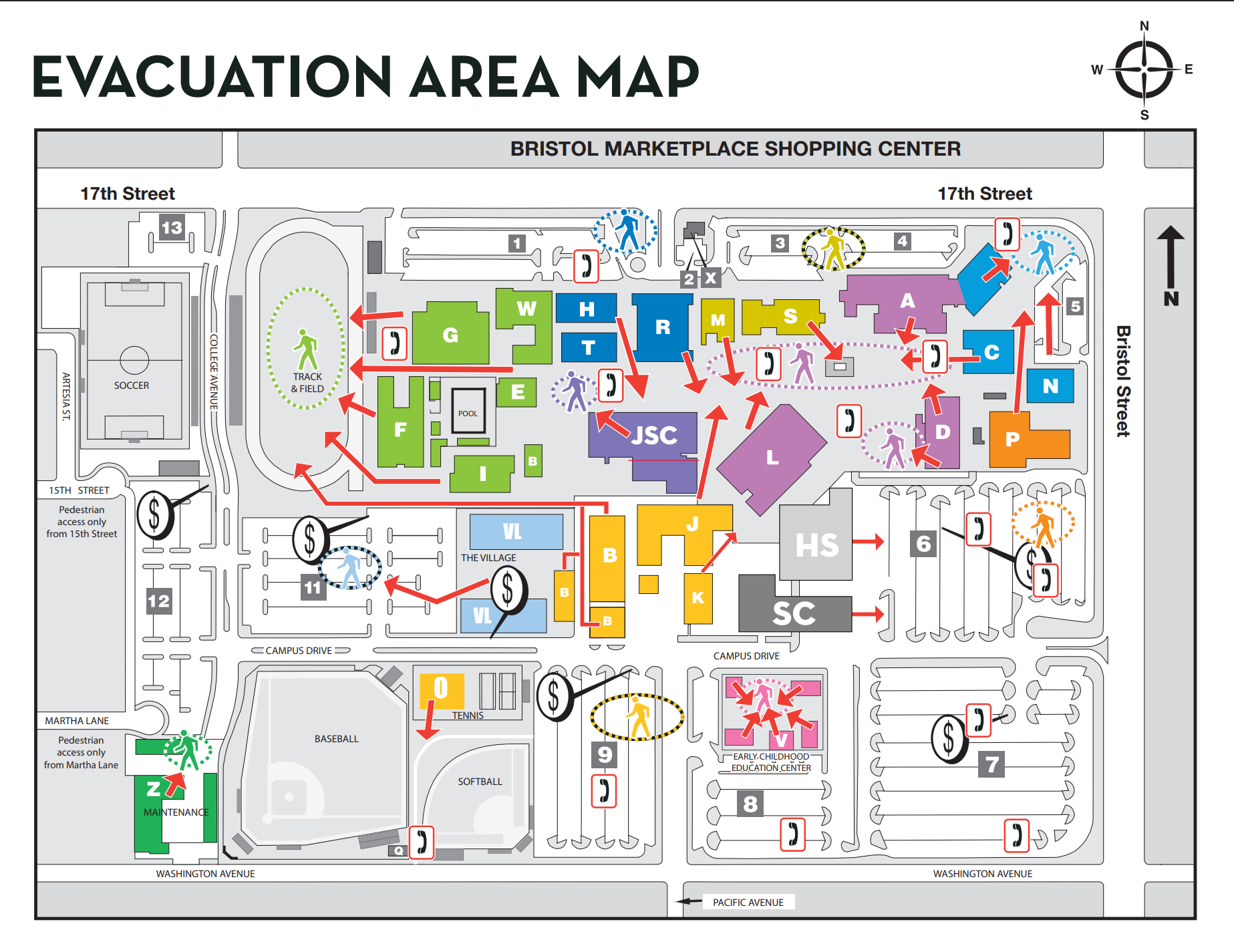
The Campus Safety & Security Office is located in the X Building on campus.
Telephone number is (714) 564-6330 (or 333 from a campus phone).
Anyone needing assistance may come to the office or use an emergency blue phone, located throughout the campus. After hours the patrol officers can be reached by calling the office phone or by using one of the emergency blue phones.
Safety Videos
Run Hide Fight Video
No one wants to think about an active shooter on campus. We have all probably heard stories though, of shootings from across the United States. An active shooter is one situation where your behavior and the actions you take can have a tremendous impact on whether you survive or not. You can view this brief video presentation that provides critical guidance on how to recognize and survive an active shooter situation. A closed captioned copy of this video is available; please contact Don Maus at 714-480-7330 for a copy.
Student Emergency Procedures Video
A closed captioned copy of this video is available; please contact Don Maus at 714-480-7330 for a copy.
Helpful Information
Crime Statistics
All crimes or serious incidents that occur on campus should be reported to the district safety and security department. Crime report logs for the district are maintained and available for review at the district safety office at Santa Ana College.
Crime Log
-
Crime Log
Current and Past Reports
The Federal Student Right-to-Know, Crime Awareness and Campus Security Act is now
cited as the, "Jeanne Clery Disclosure of Campus Security Policy and Campus Crime
Statistics Act." It requires colleges and universities to prepare, publish and distribute
a report concerning campus crime statistics and security policies annually through
appropriate publications, mailings or computer network to all current students and
employees, and to any applicant for enrollment or employment request. This report
contains the annual report concerning specific campus arrest and crime statistics
as well as information about campus programs and activities intended to promote crime
awareness, campus safety and security.
The report complies with the provisions as codified in: (1) United States Code, Title
20, Section 1092(f) and amendments of 1992 1998;(2) United States Code of Federal
Regulations, Title 34, Chapter VI, Part 668, Section 668.47; and (3) California Education
Code, Sections 67380 through 67385. For further reference please download the RSCCD Annual Security Report (PDF format).
Disclosure/Dissemination of Crime Information
The district advises members of the campus community on a timely basis about campus crime and crime-related problems. This information is disseminated by 1) an annual report, widely distributed to the media, prospective students and all members of the campus community; 2) periodic safety bulletins distributed to students, staff and faculty; 3) articles in the student newspaper (El Don); and 4) special alerts distributed selectively to campuses or throughout the district. Annual crime statistics are also reported to the U.S. Department of Education.
Crime Prevention
No community, of course, can be totally risk-free in today's society. Students, faculty, staff and visitors are partners in creating an atmosphere that is safe and conducive for learning. Everyone is asked to assist in making the campus a safe place by being alert to suspicious situations or persons and by reporting them to District Safety & Security.
-
If you are the victim or witness to any violation of the law, such as assault, robbery, overt sexual behavior, etc., immediately contact District Safety & Security or call 911.
-
Do not attempt to apprehend or interfere with the criminal except in the case of self defense. Do not take any unnecessary chances!
-
If a person becomes disruptive (violent, threatening, bizarre behavior), immediately notify your supervisor and contact District Safety & Security.
-
IF IN IMMEDIATE DANGER shout, yell for help, send a runner for help, make noise in any other way you can. Pull a fire alarm, run, try to make your way towards a phone and call 911.
The district contributes toward crime prevention and security awareness through the following:
-
Escort program - Safety officers and student security assistants are available to escort persons on campus, particularly during hours of darkness.
-
New student, faculty and staff orientation - The district safety department participates in security orientation programs for new personnel and students.
-
Emergency telephones – Emergency phones are located along the main malls and in the parking lots at SAC, SCC, and CEC. The telephone number is (714) 564-6330 (or 333 from a campus phone).
-
Bicycle patrols - Orange-vested student security assistants and uniformed safety officers patrol the campus grounds on bicycles and on foot. This is in addition to the continuing vehicular security patrols of the campus.
-
Crime prevention bulletins – These bulletins offer suggestions on implementing individual security programs.
-
Crime and safety alert bulletins – These are posted in locations whenever a serious crime has been committed or safety concern exists, to alert students and staff to be aware and alert.
-
Crime Tips – The district participates in the OC Crime Stoppers program. This program provides a safe and anonymous way for community members to report criminal activity. To report criminal activity, call OC Crime Stopppers at (855) TIP-OCCS or submit a tip on the OC Crime Stoppers website.
Drug, Weapons And Alcohol Policies Zero Tolerance Program
In accordance with Public Law 101-226, "Drug Free Schools and Communities Act Amendment of 1989", the Board of Trustees of Rancho Santiago College Community College District prohibits the unlawful possession, use or distribution of illicit drugs, alcohol, or weapons by students and employees on District property and/or as part of any District-sponsored or sanctioned activity the States underage drinking laws will be enforce as will all Federal and State drug laws. Any student or employee in violation of this policy is subject to disciplinary action up to, and including, expulsion from the college, or termination from employment for violation of the standards of conduct.
Victims Assistance Programs/Sexual Assault Programs
The district promotes a program of information, advocacy and support of victims of crime on campus. District Safety & Security and local police departments conduct full investigations of all crimes and will provide you with needed reports. California has a network of programs and resources available to help victims of crime. You may call the Victims of Crime Resource Center (1-800-VICTIMS) to obtain additional assistance. Local Orange County (1-949-975-0244).
Through the Health & Wellness Center, Santa Ana College offers educational programs to promote the awareness of rape, acquaintance rape and other sex offenses. These sexual assault programs are aimed at the prevention of sex offenses and the procedures to be followed once a sex offense had occurred.
Resources and assistance are offered through the Crisis Intervention Team (CIT), Campus Rape Center and a group seminar (Health Center Referrals for Mental Health). Potential actions, which may be imposed following the final determination of an on-campus disciplinary procedure regarding sexual offenses, are:
-
dismissal,
-
suspension,
-
probation, and
-
referral to local law enforcement agencies for prosecution.
In the event of a sex offense, students should immediately contact the District Safety
office. Presentation of evidence in such cases is essential to successfully prosecution
of assailants. An on-campus disciplinary hearing will be held in cases of alleged
sexual assaults. The accuser and the accused are entitled to the rare opportunity
to have others present during such a hearing. Both the accuser and the accused shall
be informed of the outcome of this hearing. Students have the option to notify law
enforcement authorities and District Safety, and will be arrested by campus authorities
in notifying police agencies. Victims of sexual assault will have the option of changing
academic venues if so requested by the victim, and if such changes are reasonably
available.
Victims of Crime
-
Crisis Counseling: (949) 854-3554
-
Emergency Shelter: (949) 854-0180
-
Sexual Assault Victim Service: (949) 975-0244 or (714) 834-4317
-
Child Abuse Registry (24hour line): (714) 938-0505
-
California Attorney General¹s Office of Victim's Services: (877) 433-9069
-
Orange County Human Relations Commission: (714) 567-7470
-
American – Arab Anti-Discrimination Comm.: (714) 636-1232
-
Anti Defamation League: (714) 979-4733
-
Gay/Lesbian Community Center: (714) 534-0862
-
Japanese/American Federation: (714) 626-4471
-
Korean/American Federation: (714) 530-4810
-
Los Amigos: (714) 758-8090
-
NAACP: (714) 543-3637
-
O.C. Asian Pacific Islander Community Alliance: (714) 636-9095
-
Vietnamese Community of O.C. Inc.: (714) 558-6009
BP 5500 Standards of Student Conduct
References:
- Education Codes 66300 and 66301;
- ACCJC Accreditation Standards I.C.8 and 10 (formerly II.A.7.b)
Guidelines for Student Conduct are set forth in the California Education Code, California Administrative Code, Title V, policies of the Board of Trustees, and all civil and criminal codes. Students enrolling in district educational programs assume an obligation to obey state law and district rules and regulations governing the conduct of students.
Students who enroll in those instructional programs in which the college has affiliations with various outside associations must comply with the college's policies and procedures and also with the outside associations' policies and procedures. This includes but is not limited to students enrolled in the programs of Cosmetology, Fire Academies, Criminal Justice Academies and Nursing.
I. GUIDELINES FOR STUDENT CONDUCT
The following represent violations for disciplinary action, up to but not limited to expulsion, that may be taken:
A. Dishonesty, cheating, plagiarism, lying, or knowingly furnishing false information to the district or a college official performing their duties.
B. Forgery, alteration, or misuse of district documents, records, or identification.
C. Willful misconduct that results in damage to any real or personal property owned by the district or district employees (damage includes, but not limited to vandalism, such as cutting, defacing, breaking, etc.).
D. Obstruction or disruption of pedestrian or vehicular traffic or of teaching, research, administration, or of other district activities on or off District premises. This includes obstruction or disruption of administration, disciplinary procedures or authorized college activities.
E. Assault, battery, or any threat of force or violence upon a student, college personnel, or campus visitor; willful misconduct which results in injury or death to a student, college personnel, or campus visitor. This includes fighting on district property or at a district sponsored event, on or off district premises.
F. Detention of any person on district-owned or controlled property or at district-sponsored or supervised functions or other conduct which threatens or endangers the health or safety of another.
G. Theft of any property of the district which includes property of a member of the district community or a campus visitor.
H. Unauthorized entry into or unauthorized use of district property, supplies, equipment, and/or facilities.
I. Misrepresentation of oneself or of an organization to be an agent of the district.
J. Sexual assault or physical abuse, including rape, forced sodomy, forced oral copulation, rape by a foreign object, sexual battery, or threat or assault, or any conduct that threatens the health and safety of the alleged victim, which includes students, college personnel, or campus visitors.
K. Use, possession, distribution, or being under the influence of alcoholic beverage on district property or at any district sponsored event.
L. Use, possession, distribution, or being under the influence of narcotics, other hallucinogenic drugs or substances, or any poison classified as such by Schedule "D" in Section 4160 of the Business and Professions Code on District property or at any District-sponsored event except as expressly permitted by law.
M. Expression which is libelous, slanderous, obscene or which incites students so as to create a clear and present danger of commission of unlawful acts on district premises, or violation of district regulations, or the substantial disruption of the orderly operation of the college.
N. Engaging in lewd, indecent, or obscene behavior on district property or at any district-sponsored function.
O. Possession or use while on the district premises, or a district-sponsored function, of any firearm, knife, explosive, or other dangerous object, including but not limited to any facsimile firearm, knife or explosive. Exceptions include those participating in a criminal justice educational program who are authorized such possession or those who are enrolled in a course which authorizes such possession.
P. Unauthorized preparation, giving, selling, transfer, distribution, or publication, for any commercial purpose, of any contemporaneous recording of an academic presentation in a classroom or equivalent site of instruction, including but not limited to handwritten or typewritten class notes, except as permitted by any district policy or administrative regulation.
Q. Engaging in harassing or discriminatory behavior based on disability, gender, gender identity, gender expression, nationality, race, or ethnicity, religion, age, sexual orientation or any other status protected by law.
R. Continuous disruptive behavior or willful disobedience, habitual profanity or vulgarity, open and persistent abuse of college personnel, or open and persistent defiance of the authority of college personnel, which includes physical as well as verbal abuse, including the use of racial epithets and hate speech;
S. Disruptive written or verbal communication, vulgarity, open and persistent abuse of other students which include verbal abuse, racial epithets and hate speech. Engaging in intimidating conduct or bullying against another student through words or actions, including direct physical contact; verbal assaults, such as teasing or name-calling; social isolation or manipulation; and cyberbullying.
T. Willful or persistent smoking in any area where smoking has been prohibited by law or by regulation of the Board of Trustees;
U. Violation of the Computer Usage Policy is applicable to students using computer classrooms, computer labs, the wireless network or other locations on and off district property. A violation is considered any of the following:
altering, damaging, deleting, hacking, destroying, or otherwise using any data, computer, computer
system, computer software and programs, or computer network belonging to or used by the college or
any member of the District.
computer, computer system, or computer network, or taking or copying any supporting documentation,
whether existing or residing internal or external to a computer, computer system, or computer
network belonging to or used by the college or District.
V. Any act constituting good cause for suspension or expulsion, or violation of district policies or campus regulations.
II. DISCIPLINARY ACTIONS FOR STUDENTS
Student conduct must conform to the standards established by the Board of Trustees.
Violations are
subject to the following types of disciplinary actions. (These disciplinary actions
are listed in
degree of severity, but not necessarily in sequential order. Disciplinary actions
may be imposed
singly or in combination.)
A. WARNING - Verbal notice to the student that continuation or repetition of specific
conduct may
be cause for other disciplinary action.
B. REPRIMAND - Written reprimand for violation of district rules, with copy to the
student and to
the student disciplinary file. A reprimand admonishes the offender to avoid any future
infractions
of district rules.
C. PROBATION - Probation is a disciplinary action which allows the offender to return
to the
district with the understanding of expected appropriate future behavior. Probation
may include
exclusion of the individual(s) from extra-curricular district activities that would
be set forth in
the written notice of probation. The probation would be for a specified period of
time and
appropriate notice will be sent to any advisor(s) of student organizations(s) involved.
Any further
violations of the Standards of Student Conduct during this probationary period will
result in
further, more serious disciplinary action against the offender.
D. RESTITUTION - Reimbursement by the offender(s) for damage(s) or for the misappropriation
of
district property may take the form of appropriate community service to repair or
otherwise
compensate for damage(s) or loss(es).
E. REMOVAL - An instructor or department administrator may remove a student from
his or her class
or departmental service for up to two days, and shall report all such action to the
academic dean
of the appropriate division and to the administrative designee responsible for student
discipline.
The administrative designee responsible for student discipline may suspend privileges
from that
class, campus service, office, department, or the entire campus based upon the violation,
for up to
ten days.
During the period of the removal, the student shall not be returned to a class from
which he or she
was removed without the concurrence of the instructor and administrative designee
responsible for
student discipline; nor shall the student be returned to the service, department,
office from which
they were removed, or the campus, without concurrence of appropriate administrator.
If the student is a minor, the college president, or designee shall ask the parent or guardian to removal as soon as possible, and if the attend a conference regarding the parent so requests, the Dean of Student Affairs or designee at Santa Ana College or the Vice President of Student Services or designee at Santiago Canyon College shall attend (depending on the college).
F. SUSPENSION - The Board of Trustees, the chancellor or the chancellor's designee
may suspend a
student for good cause, as defined in Section I, A-V herein, for any of the following
periods:
present on any campus of the district for the period of the suspension. The chancellor or designee
may impose a lesser disciplinary sanction than suspension, including, but not limited to warning,
reprimand, probation, restitution or ineligibility to participate in co-curricular activities or
any combination of the listed options.
G. EXPULSION - Expulsion may be for good cause (refer to Section I, A-V), when other
means of
correction fail to bring about proper conduct, or when the presence of the student
causes a
continuing danger to the physical safety of the student or others.
III. DUE PROCESS
No student shall be suspended for more than ten days or expelled unless the conduct
for which the
student is being disciplined is related to college activity or attendance, and the
student is
afforded the right of due process.
The chancellor or designee shall, prior to the suspension or expulsion of any student,
notify the
appropriate law enforcement authorities of the county or city in which the college
is situated of
any acts of the student which may be in violation of Section 245 of the Penal Code.
Violations of
any law, ordinance, regulation, or rule regulating, or pertaining to, the parking
of vehicles shall
not be cause for suspension or expulsion. However, repeatedly ignoring or consistent
violations of
parking rules, regulations, laws or ordinances may result in vehicles being towed
or loss of
parking privileges.
During the due process investigation period and hearing, the designated investigating
administrator
may allow, disallow and/or select individuals who will be included in the process.
For actions
regarding minor students, parental notification and/or involvement is required.
A. Suspension
Any suspension of more than ten days must be accompanied by a due process hearing
as outlined in
Section IV of this policy.
Whenever a minor student is suspended from a college of the District, the parent or
guardian shall
be notified in writing by the chancellor, or a designee.
B. Expulsion
Only the Board of Trustees may expel a student. Expulsion shall be accompanied by
a due process
hearing as outlined in Section IV of this policy.
IV. DUE PROCESS HEARING
1. A student who is being considered for suspension or expulsion shall be afforded
a due process
hearing before a Disciplinary Hearing Board designated by the chancellor or the chancellor’s
designee. The chancellor or designee shall provide that a reasonable opportunity
for a hearing is
afforded the student within ten days.
2. The Disciplinary Hearing Board shall be composed of the following individuals
appointed by the
chancellor or designee:
1 RSCCD Student
1 Administrator
1 Faculty Member
1 Classified Staff
3. The student shall be notified in writing at least two school days before the hearing
of the
following:
sexual history may be introduced as part of the testimony, except that the past sexual history of
the alleged victim shall be permitted if offered as evidence of the character or trait of character
of the victim for the purposes described in California Evidence Code 1103.
4. The hearing board shall hear evidence and witnesses presented by the district
and by the
student. In the event the student for whom the hearing is held, or other key parties,
is not
present at the hearing, the Hearing Board will proceed without the individual(s).
The Hearing
Board shall render its decision on the evidence presented within two school days of
the close of
the hearing. The hearing board shall notify the Dean of Student Affairs at Santa Ana
College or the
Vice President of Student Services at Santiago Canyon College or their designee of
the decision and
will notify the student by certified mail of the outcome of the hearing. If the recommendation
is
for suspension or expulsion, the student will be notified in writing of their right
to appeal the
decision to the Board of Trustees.
Any request by the student to appeal the decision to the Board of Trustees must be
made within
forty-eight hours of receipt of the letter sent by the aforementioned administrator
outlining the
hearing board’s decision. If the decision supports a recommendation for expulsion,
the suspension
will continue until the Board of Trustees can hear the appeal.
If the recommendation opposes suspension or expulsion, the recommendation shall be
final, and, the
chancellor or designee shall reinstate the student immediately to their status prior
to the
hearings.
The Board shall, unless a request has been made by the student for an open session,
hold closed
sessions under the following conditions:
(a) If the Board is considering the suspension or expulsion of the student.
(b) If a public hearing upon such question would lead to the giving of
information concerning the
student which would be in violation of Section 76243 of the Education
Code.
5. Before calling such closed session, the chancellor or designee shall, in writing,
by registered
or certified mail, if the student is a minor notify the parent or guardian, or the
student, if the
student is an adult, of the intent of the Board to call and hold such closed session.
Unless the
student, or the student's parents (if the student is a minor) within forty-eight hours
after
receipt of such written notice, request in writing that the hearing be held in open
session, the
appeal shall be conducted in closed session. If such written request is served upon
the clerk or
secretary of the Board, the meeting shall be public except that any discussion at
such meeting that
might be in conflict with the right to privacy of any other student shall be in closed
session.
Whether the matter is considered at a closed session or open meeting, final action
of the Board
shall be taken at a public meeting and the result of such action shall be a public
record of the
district.
6. The appeal before the Board of Trustees shall be a review of the evidence presented
to the
Hearing Board, and an opportunity for both sides to present oral argument. No new
evidence or
witnesses will be heard unless the Board of Trustees so requests.
7. The decision of the Board of Trustees shall be final. Students expelled or suspended
for more
than one academic year from attendance at colleges or programs of the district shall
be entitled to
make an annual appeal to the Board of Trustees of the expulsion or suspension by written
request
directed to the Secretary of the Board that the matter be placed on the agenda of
the Board of
Trustees. Such appeals shall be conducted as provided in this policy.
Additional copies of the following Rancho Santiago Community College District student
policies are
available in the RSCCD catalog and the offices of Student Services at both Santa Ana
College and
Santiago Canyon College:
• Student Code of Conduct
• Sexual Harassment Policy/Complaint Procedures
• Academic Honesty Policy
• Grievance Procedures for Students
Revised July 21, 2014 (Previously BP5201)
Local, State, and Federal Resources
A number of resources are available for campus constituents to learn more about maintaining a safe campus environment.
Local
- Santa Ana College Safety & Security
- Santa Ana Police Department
- Orange County Fire Authority
- Orange County Sheriff's Department
- City of Santa Ana
- Orange County Emergency Management
- Orange County Red Cross
State
- California Department of Homeland Security
- California Earthquake Preparedness
- California Highway Patrol
Federal
Services
Besides providing general safety and security, District Safety Officers may perform the following services:
-
Render first-aid when the Health Center is closed (Call 714-564-6330 for Emergencies - or 333 from a campus phone).
-
Respond to emergencies on campus.
-
Provide lost-and-found property services.
-
Assist in starting vehicles by jump-starting dead batteries.
-
Take crime reports, assist in the recovery of stolen property, and help the parties involved contact the police department when necessary. Provide directions and information regarding campus facilities and events.
-
Assist with traffic accidents on campus.
-
Provide escort services for staff and students returning to their vehicles after dark.
-
Direct a contingency of student security assistants who patrol parking lots and provide escort services.
-
Support the College Injury and Illness Prevention Program through periodic safety inspections of all campus buildings and grounds.
Campus Enforcement Authority and Inter-Agency Relationships
District Safety Officers receive their authority from the Board of Trustees of RSCCD and the penal, education and vehicle codes of California. Officers are non-sworn and do not possess Peace Officer status. They are authorized to make arrests by provision of section 837 of the penal code. Safety Officers are authorized to enforce traffic and parking regulations on District campuses. They may issue citations for parking violations at Santa Ana College, CEC, OEC and Santiago Canyon College. The District Safety Department maintains a close working relationship with local police departments and other state and federal law enforcement agencies. Local police departments respond to crime scenes, take police reports from victims and provide investigative forensic services as required for all serious crimes. Colleges will respond to all crime reports in a timely manner.
Access to Campus Facilities
Most campus buildings are open from 7:00AM to 10:30PM. Students and staff members may be asked to produce identification if there is a question about authorization to be in a specific area. Individuals who need to be in campus buildings or areas during other than regularly schedule work hours should obtain approval from supervisors and notify the Safety Department of their presence during off-hours. Many campus buildings will normally be locked from 10:30PM on Friday until 6:30AM on Monday. Persons entering the Campus without lawful business are subject to arrest. District Safety Officers will unlock doors for weekend classes and other events as published in the Security Facility Listings prepared by the Facilities Office. It is the responsibility of those who use rooms, offices and areas to lock access doors, turn off lights, and close windows. Custodian and Safety personnel will check many of the areas of the campus during off-hours, but the primary responsibility for security lies with the user.
College Property
No District property may be removed from the campus without expressed written permission from the department chairperson or supervisor. Unauthorized removal of District property from the campus is a violation of the law and may result in prosecution.
Maintenance and Security Of Campus Facilities
The Maintenance, Custodial, Grounds and Safety Departments combine to enhance the District's maintenance and security of campus facilities. Exterior doors on campus are secured each evening by custodians and Safety Officers. Building burglar and fire alarms are monitored by the Safety Department and private alarm companies. Grounds staff routinely trim trees and bushes to reduce potential safety hazards. Lighting is checked daily. Security hardware deficiencies are reported during continuous watch tour inspections by Safety Officers and are repaired promptly. All members of the community can report maintenance/security deficiencies by submitting Hazard Reporting Notices, or work orders. Exterior doors, especially classroom doors, should not be propped open.